


Does your rhinitis come back every time the seasons change?
If your allergies keep coming back and medication alone has not been enough, an accurate diagnosis of the cause comes first. Our clinic offers two detailed tests, MAST and ImmunoCAP, as well as the histamine–immunoglobulin injection and sublingual immunotherapy for house dust mites.

Comparing the tests MAST · ImmunoCAP
We recommend the test that suits your symptoms and purpose. Both tests are done at our clinic. The ImmunoCAP test may be covered by National Health Insurance depending on the clinical situation, such as a follow-up visit.
MAST test
Insurance-covered if eligibleA comprehensive test that checks your reactions to a wide range of inhaled and food allergens at once, from a single blood draw.
- Scope
- About 90–100 allergens in one test
- Results
- Results 3–5 days after the test
ImmunoCAP test
Insurance may applyPinpoints suspected allergens and measures them as numerical classes, for detailed diagnosis and treatment planning.
- Scope
- Precisely measures specific allergens as quantitative values (classes)
- Results
- Depends on the items tested
Which test should I take?
Find the situation closest to yours. The exact choice of test is made together with the medical team during your consultation.
Who the MAST test is for
- People whose hives, sneezing or runny nose keep coming back for no clear reason
- People who need a full allergy check before starting a job
- People who have long struggled with atopic dermatitis, chronic hives or asthma
- Parents whose child regularly gets stuffy-nose colds or itchy skin again and again
Who the ImmunoCAP test is for
- People who react right after eating a particular food (for example, shrimp)
- People who need to find out exactly which foods affect their allergies
- People who need more precise numerical measurements
Breathing function test Spirometry
This test checks how well you breathe. Whether you need it is decided with the medical team, based on your symptoms and examination findings.
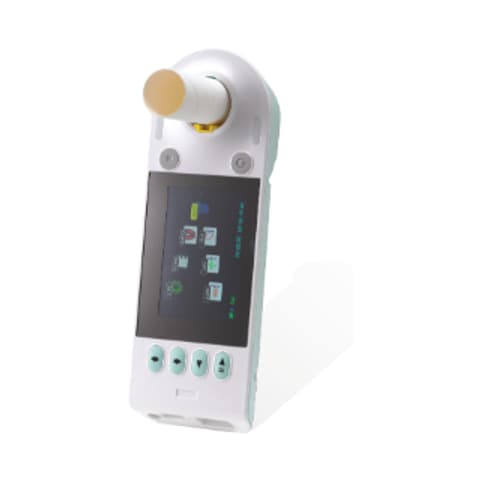
Spirometry
Spirometer AVAD-9
Assesses lung function by measuring lung capacity and airflow as you breathe in and out. When needed, measurements taken before using a bronchodilator are compared with those taken after.
Allergy injection Histamine–immunoglobulin
A treatment that suppresses allergic hypersensitivity reactions by repeatedly giving an injection that contains both histamine and human immunoglobulin. Unlike immunotherapy that uses the allergen causing your symptoms, it works regardless of the type of allergen.
Dosing schedule
- Step 1
Initial
3 doses at 1-week intervals (1 vial per dose)
- Step 2
Checking the effect
If the effect is minimal within 1 month, 1–2 more treatment cycles in the same way
- Step 3
Maintenance
After 3 treatment cycles, 1 vial every 3 months as maintenance
Who it is for
- Bronchial asthma
- Chronic hives
- Allergic rhinitis
We recommend it, after discussion with the medical team, to people who feel medication alone is not enough or whose symptoms keep coming back.
Precautions (tell us beforehand)
If any of the following apply to you, be sure to tell the doctor before treatment.
- People having a severe allergic attack
- Women just before or during their period
- Women who are pregnant or may be pregnant
- Patients who are markedly weak
- Patients with a history of hypersensitivity to any ingredient of the medicine
- Patients with a history of allergy to any ingredient of the medicine
Sublingual immunotherapy for house dust mites
An immunotherapy that is easy to take: you place the medicine under your tongue, so it is less of a burden.
- Who it is for
People whose allergy test shows house dust mites as a main cause
- Medicines we have
There are two types of tablets that dissolve under the tongue. We will tell you which one to use after your consultation.
- Treatment period
Taking it steadily over a long period is recommended. We will explain the detailed schedule during your visit.
Limitation It cannot be used for other allergens (such as pollen, animal hair or food).

Related care Nose care
Rhinitis · Allergic rhinitis
Allergy tests and treatment FAQ
Common questions about MAST and ImmunoCAP tests and allergy treatment.
What kinds of allergy tests are there?
The MAST test is a comprehensive test that checks about 90–100 allergens at once, and it is covered by National Health Insurance when the coverage criteria are met. The ImmunoCAP test measures specific allergens as quantitative values (classes) and is used for detailed diagnosis of asthma, atopic dermatitis, contact dermatitis and more. Both tests are available at our clinic, and we recommend the right test based on your symptoms and the allergens suspected.Is the MAST test covered by National Health Insurance?
The MAST test is covered by National Health Insurance when the coverage criteria are met, which lowers your cost. The ImmunoCAP test may also be covered by National Health Insurance when the coverage criteria are met, depending on your situation, such as a follow-up visit. We will explain in detail after your consultation whether coverage applies and what your out-of-pocket cost will be.When will the test results be ready?
MAST results are usually available 3–5 days after the test. ImmunoCAP results are given separately, depending on the items tested and how the test progresses. When the results arrive, the medical team explains your reaction to each allergen and the management and treatment plan that follows.Who is the histamine–immunoglobulin injection recommended for?
It is a treatment that may help people with bronchial asthma, chronic hives or allergic rhinitis who feel that medication alone is not enough. The injection contains histamine together with human immunoglobulin, and unlike immunotherapy that uses the allergen causing your symptoms, it works regardless of the type of allergen. However, the possibility of pregnancy and any history of hypersensitivity to its ingredients need to be checked beforehand, so please talk to the doctor during your visit.How long does histamine–immunoglobulin injection treatment take, and how many injections are needed?
At first, it is given 3 times at 1-week intervals (1 vial per dose). If the effect is minimal within 1 month, 1–2 more treatment cycles are repeated in the same way. After 3 treatment cycles, 1 vial is given every 3 months as maintenance. We will explain the detailed schedule during your visit.Who can have sublingual immunotherapy?
Sublingual immunotherapy at our clinic is a treatment specifically for house dust mite allergy. It is simple to take, so it is less of a burden for patients, but it cannot be used for other allergens. We recommend it when an allergy test confirms that house dust mites are the main cause.Is there anything I should know before an allergy test?
Some medications, such as antihistamines and steroids, can affect the test results, so you may need to stop them for a period as instructed beforehand. If you take any regular medication, please tell us during your visit. The test itself is a blood draw, so no fasting or special preparation is needed.
Allergy health info (in Korean)
All health articles →From detailed allergy diagnosis to immunotherapy
We recommend the right test based on your symptoms and the allergens suspected.